
Swatch Group has publicly challenged the Morgan Stanley Swiss watch report, disputing several brand-level estimates and questioning the methodology behind one of the industry’s most widely cited analyses. The Swatch Group Morgan Stanley watch report dispute highlights a broader issue within Swiss watchmaking. Much of the market is interpreted through models built on incomplete data.
What the Morgan Stanley Swiss watch report is
The Swatch Group Morgan Stanley watch report dispute centres on an annual industry analysis produced by Morgan Stanley in collaboration with consultancy LuxeConsult. It attempts to estimate the relative scale of major Swiss watch brands by combining Swiss export statistics, retailer feedback and analyst modelling. Because most watch manufacturers do not disclose detailed brand-level financial data, the report has become one of the most widely cited attempts to map the structure of the Swiss watch industry.
Why the Swatch Group Morgan Stanley watch report dispute matters
The dispute between Swatch Group and the annual Swiss watch industry report produced by Morgan Stanley in collaboration with LuxeConsult has become one of the most widely discussed stories in the watch sector this year.
For more than a decade the Morgan Stanley Swiss watch report has been cited by analysts, journalists and collectors when discussing the relative scale of major Swiss watch brands. Its brand rankings and estimated revenues circulate widely because detailed brand-level financial data is rarely disclosed by watch manufacturers.
Swatch Group’s decision to publicly challenge the report has therefore triggered a broader conversation about how the Swiss watch industry is analysed and how much confidence should be placed in figures derived largely from estimates.
What the Swiss watch industry report landscape looks like
The Morgan Stanley Swiss watch report is not the only attempt to analyse the structure of the watch industry. Several institutions produce research examining the global watch market, although few focus specifically on Swiss mechanical watchmaking at brand level.
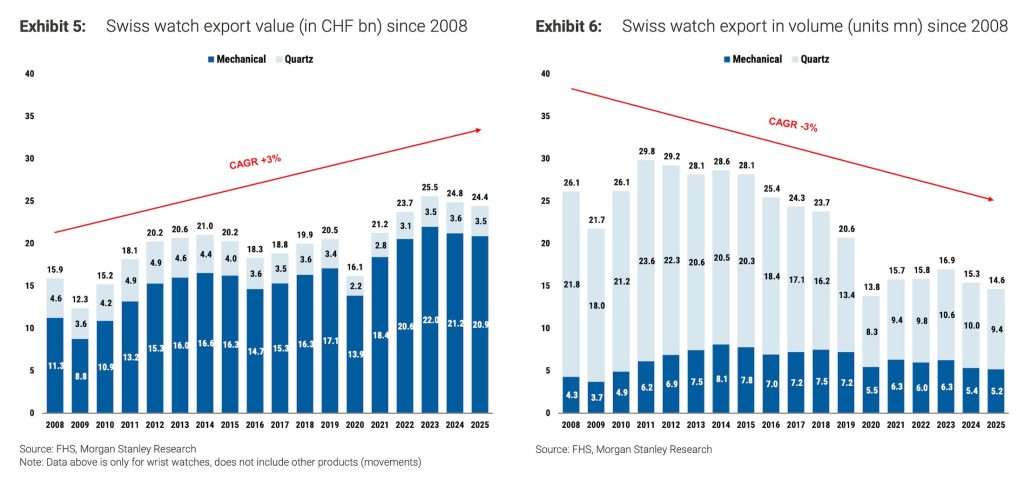
Most available data originates from export statistics published by the Federation of the Swiss Watch Industry. These monthly reports track the value and volume of watches exported from Switzerland and provide the most reliable publicly available measure of industry performance.
However export statistics do not identify which brands account for those sales. As a result analysts attempting to produce a Swiss watch industry report must rely on additional sources such as retailer feedback, production capacity estimates and industry interviews.
The Morgan Stanley watch report attempts to combine these inputs into a model that estimates the scale and performance of individual brands.
What the Swatch Group Morgan Stanley watch report dispute is about
The Swatch Group Morgan Stanley watch report dispute centres on the methodology used to estimate brand performance within the Swiss watch industry.
The Morgan Stanley Swiss watch report attempts to estimate production volumes, revenues and market share by combining Swiss export statistics, analyst modelling, retailer feedback and industry interviews. These inputs are used to construct an analytical model of the market.
Swatch Group argues that several conclusions drawn from this model rely on incorrect assumptions about its brands. According to the company the resulting estimates present speculative figures with a level of numerical precision that suggests confirmed financial data.
While disagreements between companies and analysts are not uncommon, Swatch Group’s decision to challenge the report publicly has attracted attention because the company rarely comments directly on external industry research.
Key takeaways
Swatch Group has disputed the latest Morgan Stanley Swiss watch report.
The company argues several brand-level estimates used in the report are inaccurate.
Longines profitability, Tissot growth and Hamilton production volumes were among the figures challenged.
The controversy highlights the difficulty of analysing the Swiss watch industry due to limited brand-level transparency.
The Morgan Stanley watch report remains influential largely because alternative datasets are scarce. This also connects with our analysis of how pricing and perceived value are constructed in the wider watch market.
Why Swatch Group challenged the Morgan Stanley watch report

Swatch Group challenged the Morgan Stanley watch report because it believes several estimates concerning its brands are materially incorrect.
In an open response the company argued that assumptions about production volumes, pricing and profitability do not reflect its internal data. According to Swatch Group these discrepancies are significant enough to alter how certain brands appear within industry rankings.
In its public response the company published an open letter outlining its objections to the analysis. Swatch Group stated that several figures used in the Morgan Stanley watch report deviated substantially from its internal numbers and criticised the methodology used to derive brand-level estimates.
By addressing the issue directly the company made clear that its concern was not limited to a single data point but to the broader analytical framework used to interpret the Swiss watch market.
Data points at the centre of the disagreement

Several claims within the Morgan Stanley watch report became focal points in the dispute.
Longines profitability
The report suggested that Longines had become loss making. Swatch Group rejected this interpretation and stated that the brand remained profitable, reporting a margin of roughly 16.6 percent.
Tissot performance
Morgan Stanley estimated declining sales for Tissot. Swatch Group stated that the brand had instead recorded modest growth.
Hamilton production volumes
The report estimated significantly lower unit sales for Hamilton than those claimed by Swatch Group.
Average retail price assumptions
Swatch Group also criticised the retail pricing assumptions used in the report’s calculations, arguing that the implied average prices did not accurately reflect the brand’s market positioning.
These examples illustrate how sensitive industry rankings can be to underlying assumptions. Relatively small adjustments to production estimates or pricing models can change the perceived scale of a brand within analytical comparisons.
How the Morgan Stanley watch report became influential

The Morgan Stanley watch report occupies an unusual position within the watch industry. It does not rely on official brand-level disclosures, yet it has become one of the most frequently cited attempts to map the competitive landscape of Swiss watchmaking.
Part of its influence stems from the scarcity of reliable information. The industry is dominated by privately held manufacturers and conglomerates that rarely publish detailed operational data.
In this environment analysts must rely on indirect indicators to understand how the market evolves. The Morgan Stanley watch report consolidates those indicators into a structured analytical model that produces estimated rankings.
Because the model presents clear comparisons between brands its conclusions are often repeated across watch media and enthusiast discussions.
Why reliable data is difficult in the Swiss watch industry
The Swatch Group Morgan Stanley watch report dispute highlights a structural feature of Swiss watchmaking: limited transparency.
That opacity also matters when wider trade pressures distort headline numbers across the sector.
Most watch manufacturers do not publish production volumes or brand-level revenue figures. Even publicly listed groups generally release financial results only at group level.
Private companies disclose even less. Rolex, widely believed to be the largest Swiss watch brand by revenue, publishes no official production or turnover figures.
The most consistent dataset available is the monthly export statistics released by the Federation of the Swiss Watch Industry. These figures show the value and volume of watches exported from Switzerland but do not identify which brands account for those exports.
As a result attempts to estimate brand performance inevitably rely on modelling rather than confirmed financial data.
The structural issue behind the dispute
An element rarely discussed in coverage of the Swatch Group Morgan Stanley watch report dispute concerns the purpose of such reports.
Industry research produced by investment banks is primarily intended for institutional investors rather than collectors. Analysts use sector reports to understand the relative scale and positioning of companies within the broader luxury goods industry.
Within that context the Morgan Stanley watch report provides a framework for interpreting the structure of Swiss watchmaking.
Once the report’s estimates circulate within watch media however their role changes. Analytical modelling can gradually become interpreted as an industry scoreboard.
The dispute therefore reflects a tension between financial analysis and public perception within a market that discloses relatively little about itself.
How industry reports influence collector perception
Although the Morgan Stanley watch report is primarily written for investors its conclusions often circulate widely among collectors. Brand rankings and estimated revenue figures are frequently repeated in watch media and enthusiast discussions where they can influence perceptions of which manufacturers are gaining or losing momentum.
In practice the relationship between such rankings and collector behaviour is indirect. Demand for specific watches is typically driven more by design, cultural relevance and production scarcity than by overall brand revenue.
We explored a related question recently in our article on what shapes luxury watch buying behaviour.
A strong secondary market for a particular model can exist even when broader brand performance fluctuates.
Nevertheless widely cited industry reports can shape the narrative surrounding certain manufacturers. Descriptions of growth or decline may influence how collectors interpret new releases or evaluate long-term desirability.
For this reason the Swatch Group Morgan Stanley watch report dispute highlights an important distinction between analytical models of the industry and the behaviour of the collector market.
Sources and industry coverage
The Swatch Group Morgan Stanley watch report dispute has also been covered across specialist watch media, including Hodinkee and Fratello Watches.
Swatch Group’s response was published in the form of an open letter addressing the methodology used in the Morgan Stanley watch report.
Frequently asked questions
What is the Morgan Stanley Swiss watch report
The Morgan Stanley watch report is an annual analysis of the Swiss watch industry produced in collaboration with LuxeConsult. It estimates brand revenues, production volumes and market share using export statistics and industry modelling.
Why did Swatch Group dispute the report
Swatch Group stated that several estimates used in the report were inaccurate, particularly those relating to profitability, production volumes and retail pricing for some of its brands.
Are the figures in the report official
No. The report relies on estimates because most watch manufacturers do not disclose detailed brand-level financial data.
Does the report still have value
Despite its limitations the report can provide directional insight into the structure of the Swiss watch industry. Its rankings should be interpreted as analytical estimates rather than confirmed financial data.
Conclusion
The Swatch Group Morgan Stanley watch report dispute illustrates a broader challenge within the Swiss watch industry. In a market where detailed information is rarely disclosed, estimates inevitably become part of the analytical landscape.
Reports such as the Morgan Stanley watch report attempt to impose structure on a sector that reveals relatively little about its internal economics. By combining export statistics, industry interviews and analytical modelling they create a framework through which observers interpret the relative scale of different brands.
The difficulty arises when those frameworks begin to circulate as definitive measurements rather than informed approximations. Once repeated widely estimated rankings can acquire the authority of confirmed data even when the underlying figures remain unverifiable.
Swatch Group’s response therefore highlights a tension that has long existed within Swiss watchmaking. The industry values discretion and selective transparency, yet the absence of detailed disclosure inevitably invites external interpretation.
In that sense the dispute is not simply about one report or one company. It reflects a broader question about how an industry built on precision manages the interpretation of data that is, by its nature, incomplete.