The luxury watch industry is facing one of its biggest economic shake-ups in recent memory, as a fresh wave of U.S. import tariffs sends shockwaves through Switzerland’s most iconic export sector.
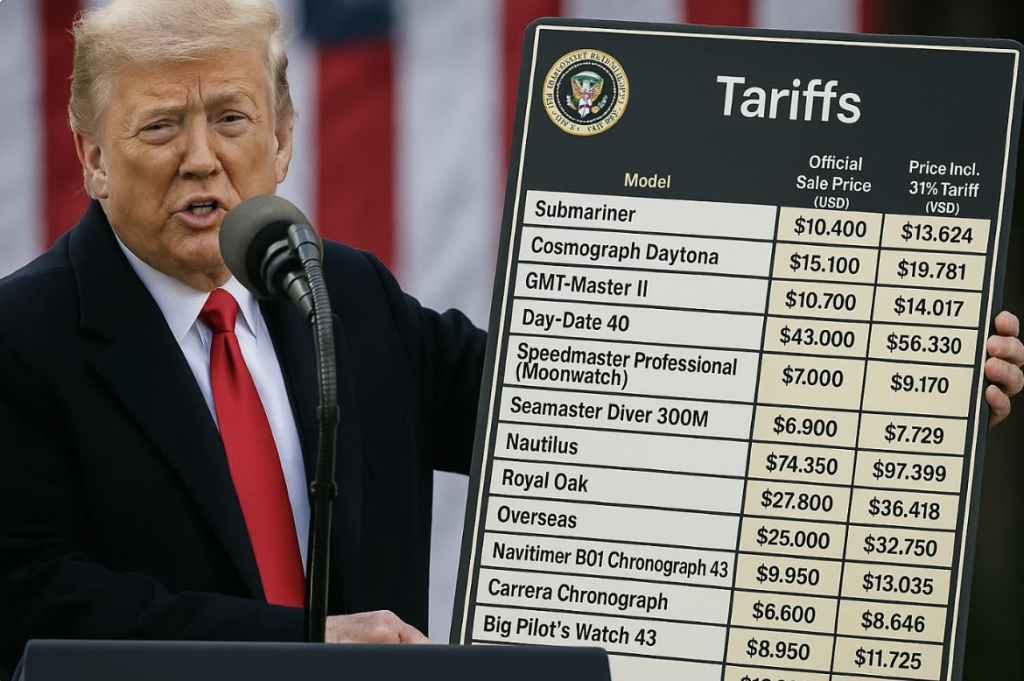
Announced earlier this week by President Donald Trump, the new measures impose a 31% tariff on Swiss imports and 20% on goods from the EU.
While the move is rooted in a broader geopolitical standoff, its immediate impact has landed squarely on the wrist of the global watch trade.
Swiss Shares Slide
Markets were swift to react. Within hours of the announcement:
- Swatch Group: ↓ 4.3%
- Richemont (Cartier, IWC): ↓ 4%
- Kering (Gucci): ↓ ~3%
- LVMH: ↓ 2.9%
- Burberry: ↓ 4.3%
- Pandora: ↓ ~13% (largely due to Thailand-based production chains)
Luxury watch brands, which traditionally enjoy a degree of insulation from political volatility, are now confronting a highly tangible threat: higher costs, thinner margins, and rising uncertainty.
Why Are Watches Being Targeted?
While the tariffs aren’t specifically aimed at horology, Switzerland’s dominance in the luxury watch market makes the industry a high-profile casualty.
“Swiss watches are not just products; they’re ambassadors of national prestige,” writes Rob Corder of WatchPro. “But they’re also easy to tax: high-value, low-volume, and globally desirable.”
The new U.S. tariffs are widely seen as retaliatory, linked to longstanding disputes over digital taxation and access to tech markets.
Watches, as high-end discretionary goods, sit right in the crosshairs.
Who’s Feeling the Pressure?
According to JPMorgan analysts, Swiss watchmakers could be among the hardest hit. “Production is centralised in Switzerland, and the U.S. is one of their largest export markets,” the bank noted. “Brands will have to either raise prices or reduce their margin.”
Some industry insiders speculate that pricing increases may have already been subtly rolled out in anticipation.
Others warn that grey market activity could increase, as U.S. consumers search for more cost-effective access to Swiss timepieces.
What Does This Mean for Collectors?
For collectors and retailers, the implications are immediate:
- Expect price increases on new watches sold in the U.S.
- Inventory pressure on retailers facing increased costs
- Greater volatility in the pre-owned and grey markets
Brands like Rolex, Patek Philippe, and Audemars Piguet could see demand shift toward international channels or secondary markets.
Meanwhile, American jewellers may struggle to justify the markup unless transparency and demand remain strong.
What’s Next?
Diplomatic discussions between Switzerland, the EU, and the United States are expected to intensify in the coming weeks. But one thing is certain: the ripple effect of these tariffs will be felt across every link of the supply chain.
At Watch & Bullion, we’ll be tracking this story closely. In the meantime, stay informed, stay sharp, and as always invest in what matters.
Got thoughts on the tariff impact? Drop us a comment or join the conversation on Instagram @watchandbullion.