Luxury watch financing, especially through Buy Now, Pay Later (BNPL) services, has surged in popularity for high-end purchases by tapping into fundamental psychological principles.
By allowing consumers to split costly items into smaller, delayed payments, BNPL is changing how shoppers experience the pain of paying and reshaping the emotional dynamics of luxury ownership.
This article examines the behavioural science behind deferred payments, verifies brand-level financing practices, and links to our previous articles on Mental Accounting and Quiet Luxury to offer a deeper understanding of how luxury watch financing is redefining value in the high-end market.
The Lure of Deferred Payments for Luxury Buyers
Deferred payment schemes appeal to our preference for instant gratification.
Spreading a large expense into manageable instalments softens the immediate sense of financial loss that a lump sum payment would normally trigger.
In behavioural economics, this effect is explained through temporal discounting: the human tendency to favour immediate rewards over future ones.

BNPL capitalises on this by separating the joy of acquiring a luxury watch from the discomfort of parting with money.
The watch is received today, but the payment is a problem for tomorrow.
Studies have shown that credit card use already dulls the psychological pain of paying.
BNPL goes a step further by delaying that pain altogether. Cheng and Huo (2025) found that consumers are more likely to make discretionary purchases when the financial cost is shifted into the future, even when the overall price remains the same.
This perceived affordability is especially persuasive when marketing high-value goods like luxury watches, where breaking a £10,000 timepiece into ten instalments of £1,000 can cognitively reframe the purchase as achievable.
Recent data also shows BNPL’s appeal extends disproportionately to consumers from financially vulnerable segments.
According to the Federal Reserve (2023), individuals with low income, minimal savings, or high credit card utilisation are significantly more likely to use BNPL.
Many report using it out of necessity rather than convenience, often because they are maxed out on traditional credit cards or cannot access conventional forms of credit (Federal Reserve, 2023; CFPB, 2023).
This aligns with the broader behavioural insight that BNPL’s frictionless nature encourages use even among those with limited financial capacity.
Impact on Spending and Financial Well-Being
Behavioural finance research indicates that BNPL not only increases transaction volume but also raises the average basket size.
A 2024 study by Maesen and Ang, published in the Journal of Marketing, found that offering BNPL options resulted in approximately nine percent more transactions and a ten percent increase in transaction value compared to traditional single payment checkouts (Maesen & Ang, 2024).

Luxury watch financing enables consumers to overcome short-term liquidity constraints.
However, the very mechanisms that make it feel manageable, such as splitting the cost and delaying the financial sting, can also obscure the long-term implications.
Papich (2022) found that heavy BNPL users were more likely to experience financial distress, including overdrafts and missed payments, particularly when juggling multiple repayment schedules across retailers.
Research by Di Maggio et al. (2023) adds that BNPL often leads to increased discretionary spending and rising overdraft fees among liquidity-constrained users.

This “liquidity flypaper effect” indicates that the extra purchasing power from BNPL tends to stick as consumption rather than improving savings or financial stability.
The Federal Reserve’s 2024 data likewise notes that BNPL users frequently exhibit high levels of credit use and carry multiple active debts, signalling a risk of overextension (Federal Reserve, 2024).
Many consumers report that BNPL was the only available method to finance their purchase.
In 2023, over 50% of users told the Federal Reserve they could not have afforded the product otherwise.
Subprime borrowers, in particular, are often approved for BNPL while being denied traditional credit cards (CFPB, 2023).
These users may carry significant financial strain into the repayment period, increasing their likelihood of defaulting or experiencing post-purchase regret.
Does “Pain-Free” Buying Affect Satisfaction?
A common assumption is that removing the pain of paying increases post-purchase satisfaction.
However, research challenges this notion. Shah, Bettman, and Payne (2016) showed that consumers who paid with cash experienced stronger emotional attachment to their purchases than those who used credit.
The act of sacrifice appears to deepen commitment and heighten the sense of reward.
In the BNPL context, this raises important questions. By making acquisition frictionless, do luxury brands risk diluting the symbolic weight of ownership?
For some consumers, yes. A 2021 C+R Research survey found that 57 percent of BNPL users reported regret over at least one instalment-based purchase (C+R Research, 2021).
Moreover, users with poor credit or limited savings or those who disproportionately rely on BNPL are also more likely to fall behind on payments.
A Kansas City Federal Reserve study found that 96% of BNPL users who missed instalments showed at least one indicator of financial distress (Hayashi & Routh, 2025). These consumers face compounding penalties, which may detract from the enjoyment and prestige typically associated with high-end watch ownership.
Luxury Watch Retailers Embrace Buy Now, Pay Later
Buy now pay later watches are now a common offering across luxury retail platforms and is a service that is now incorporated into the offerings of many authorised dealers and platforms.
Omega watches, for instance, are available through interest-free financing via authorised dealers such as Watches of Switzerland, which partners with V12 Retail Finance and PayPal Credit to offer 0% APR financing on purchases up to £50,000 (Watches of Switzerland, 2025).
Klarna is integrated into checkout systems across platforms, including Watches of Switzerland, TAG Heuer, Bob’s Watches, and eBay’s certified luxury storefront.

These services offer flexible options such as Pay in 30 or Split into 3 with zero interest for qualifying buyers (Bob’s Watches, 2025).
Watchfinder, the Richemont-owned pre-owned watch platform, prominently advertises 0 percent APR financing for eligible customers (Watchfinder, 2025).
This enables aspirational buyers to access iconic models like the Audemars Piguet Royal Oak or Rolex Submariner in monthly increments, often with no upfront fees.
Blowers Jewellers, another UK-based dealer, offers terms ranging from six months interest-free to more extended plans with competitive APR (Blowers Jewellers, 2025).
In the U.S., Bucherer 1888 and its subsidiary Tourneau, along with StockX, have partnered with Affirm to provide flexible monthly financing on luxury timepieces, making brands like Omega, Panerai, and Audemars Piguet accessible through structured instalments (Tourneau, 2025; StockX, 2025).

Even Splitit, a provider that lets buyers pay through existing credit cards without triggering new lines of credit, is now accepted by NOMOS Glashütte and other luxury brands (Splitit, 2025).
These offerings reflect a strategic shift. BNPL and luxury watch financing are no longer perceived as finance gimmicks.
They are mechanisms for broadening the customer base while preserving price integrity.
Brands are reaching a younger, digitally native and often credit-constrained audience, though this inclusivity presents new reputational and financial risks.
Brand Image, Exclusivity and Quiet Tensions
As we explored in Quiet Luxury Explained, much of modern status signalling is built on restraint, understatement and effort.
This raises an inevitable question: does the growing accessibility of BNPL risk diluting the experience of high-end watch ownership?
There is no clear consensus. On one hand, structured payment plans allow brands to reach a younger, digitally native audience without altering product quality or branding.
On the other hand, luxury is historically defined by inaccessibility, a notion complicated by point-of-sale financing.

Luxury brands must walk a careful line. While platforms such as Klarna and PayPal Credit offer flexibility, they also encourage buyers to treat exceptional items as ordinary purchases.
Some argue that this undermines the heritage and aspiration embedded in traditional watchmaking.
A Generational Shift in Luxury Spending
Millennials and Generation Z have come of age with a very different financial psychology.
They are more likely to favour flexibility over ownership, experiences over accumulation and instant access over delayed gratification.
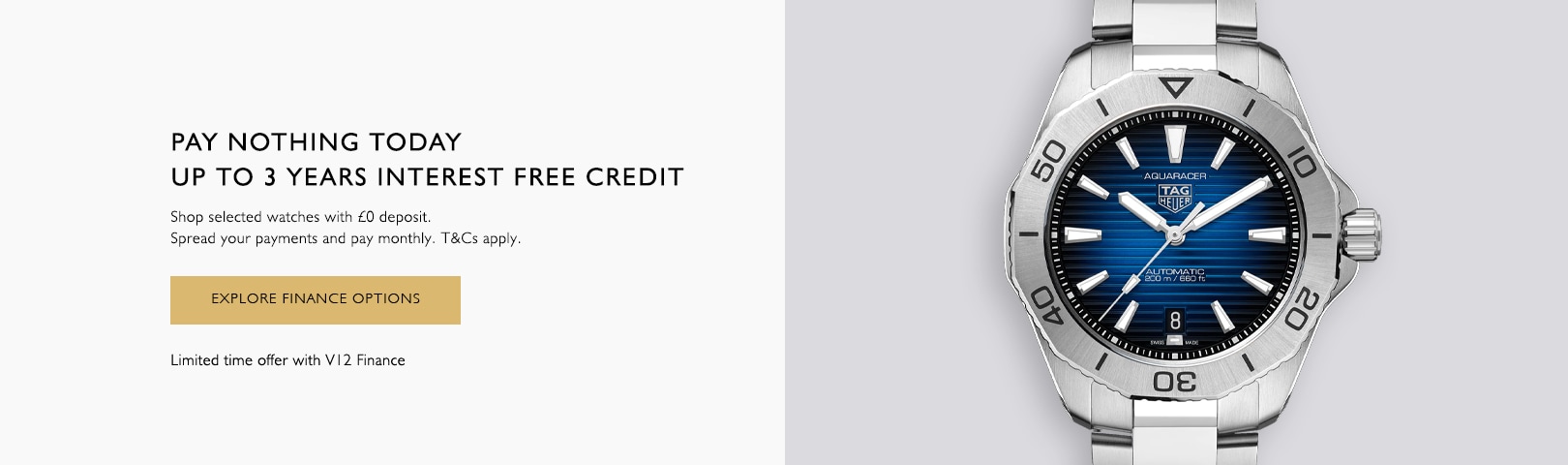
Luxury watch financing aligns closely with these values. For younger buyers, using V12 Retail Finance or Klarna to purchase a TAG Heuer or spreading the cost of an Omega over 12 months is not seen as compromising integrity.
Instead, it is viewed as a financially savvy way to access something meaningful without sacrificing liquidity.
This shift is also cultural. For previous generations, buying a luxury watch outright was often tied to a milestone, a reward for years of work.
Today, value is increasingly measured in terms of access and use rather than outright ownership.
Conclusion
Watch financing through Buy Now, Pay Later services has fundamentally reshaped the consumers retail experience.
By deferring the moment of financial sacrifice, BNPL enhances immediate gratification and increases the likelihood of purchase.
Luxury retailers have benefited from increased sales volumes and market expansion, particularly among younger and credit-fragile consumers.
Yet this convenience comes with behavioural risks. Consumers must approach BNPL with clear awareness of their financial boundaries.
When used sensibly, deferred payments can provide a bridge to aspiration without compromising long-term well-being.
Understanding the psychological levers that BNPL pulls, such as pain avoidance, time discounting and perceived control, helps both buyers and brands navigate this new purchasing landscape with confidence.
References
C+R Research. (2021). Buy Now, Pay Later Survey: 60% of Users Make BNPL Purchases Worth $100–$500.
Cheng, Y., & Huo, J. (2025). Adoption of Buy Now, Pay Later (BNPL): A Time Inconsistency Perspective. Journal of Theoretical and Applied Electronic Commerce Research, 20(2), 81. https://doi.org/10.3390/jtaer20020081
Consumer Financial Protection Bureau. (2023). The impact of Buy Now, Pay Later on credit access. https://www.consumerfinance.gov
Di Maggio, M., Ma, A., & Williams, E. (2023). Buy Now Regret Later? Liquidity Flypaper Effect and Overdrafts. SSRN Working Paper. https://doi.org/10.2139/ssrn.4401738
Federal Reserve Board. (2024). Consumer Finances and Buy Now Pay Later: Trends and Risks. https://www.federalreserve.gov
Hayashi, F., & Routh, T. (2025). BNPL and Financial Fragility. Federal Reserve Bank of Kansas City Economic Review. https://doi.org/10.18651/ER/1q25hayashi
Maesen, S., & Ang, D. (2024). Buy now, pay later: Impact of installment payments on customer purchases. Journal of Marketing, 89(3), 13-35. https://doi.org/10.1177/00222429241282414
Papich, S. (2022). Effects of Buy Now, Pay Later on Financial Well-Being. SSRN Electronic Journal. https://doi.org/10.2139/ssrn.4247360
Shah, A. K., Bettman, J. R., & Payne, J. W. (2016). Paper or Plastic?: How We Pay Influences Post-Transaction Connection. Journal of Consumer Research, 42(5), 688–708. https://doi.org/10.1093/jcr/ucv056
Watches of Switzerland. (2025). Finance options. https://www.watches-of-switzerland.co.uk/i/finance-options