The Louis Vuitton Tambour Convergence marks a meaningful step in the brand’s evolution as a serious watchmaker.
For many collectors, Louis Vuitton has historically occupied an uncomfortable space within horology. The brand’s cultural weight has often worked against it, creating scepticism among those who associate legitimacy with slower, more insular maisons.
The Tambour Convergence suggests that this period is ending.
Rather than chasing recognition, Louis Vuitton appears increasingly comfortable setting its own terms.
A Design Rooted in Watchmaking History
The Louis Vuitton Tambour Convergence draws directly from the tradition of montres à guichet.
This form of time display replaces hands with rotating discs, visible through apertures that reveal hours and minutes.
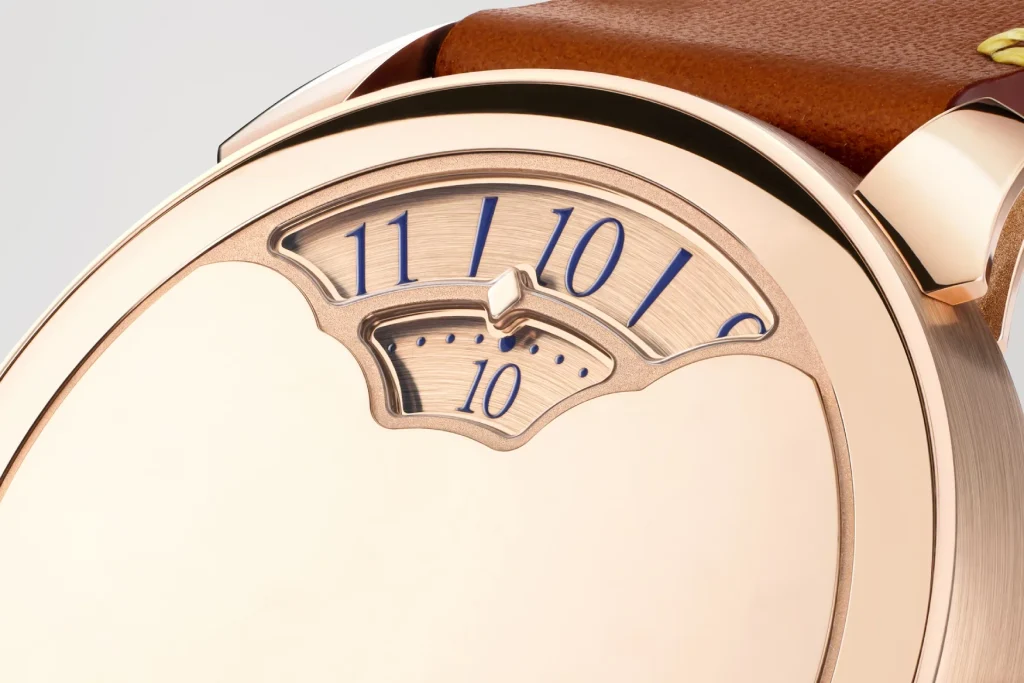
While unfamiliar to many modern collectors, this approach has deep roots in early twentieth century watchmaking.
Historically, guichet watches were associated with architectural design, clarity of intent, and a willingness to question how time should be read.
The Tambour Convergence does not treat this as nostalgia. It uses the format to slow the experience of reading time, encouraging deliberate engagement rather than instant recognition.
The Case and Its Proportions
At 37mm, the case size of the Louis Vuitton Tambour Convergence is notably restrained.
This choice feels intentional rather than conservative. In a market dominated by visual presence and wrist dominance, the Convergence favours proportion and balance.

The Tambour case itself has been refined significantly. The profile is slimmer, the transitions cleaner, and the finishing more controlled than earlier iterations.
On the wrist, the watch wears quietly and comfortably, aligning more closely with classical dress watch proportions than contemporary sports models.
Movement and Manufacture Direction
Inside the Louis Vuitton Tambour Convergence is an in house automatic movement developed by La Fabrique du Temps Louis Vuitton.
This detail is critical to understanding the watch’s position. The movement exists to support the design rather than to dominate the narrative.
It delivers reliable performance, a practical power reserve, and finishing that reflects competence rather than spectacle.
This approach reinforces a broader strategy from Louis Vuitton. The brand is prioritising manufacture capability, vertical integration, and design coherence over marketing driven complexity.

Design, Manufacture, and Leadership Context
Design and production of the Louis Vuitton Tambour Convergence take place in Geneva at La Fabrique du Temps Louis Vuitton.
The manufacture was formed following Louis Vuitton’s acquisition of the workshop founded by Michel Navas and Enrico Barbasini. It operates as an integrated environment where movement development, case construction, dial work, and finishing are developed in parallel.
This structure allows the Tambour Convergence to function as a coherent design system. The guichet display, refined case proportions, and in house calibre are conceived together rather than assembled from separate sources.
Strategic oversight of Louis Vuitton’s watchmaking direction sits within the Arnault family structure. Jean Arnault serves as director of watches at Louis Vuitton, with responsibility for product development and long term positioning.
His tenure has coincided with a clearer separation between Louis Vuitton’s fashion output and its watchmaking ambitions. The emphasis has shifted towards limited production, manufacture credibility, and design discipline.
The Tambour Convergence aligns closely with this direction. It prioritises proportion, restraint, and mechanical relevance over immediate recognition.
Reading Time Differently
The time display on the Louis Vuitton Tambour Convergence is not designed for speed.
Hours and minutes advance gradually on rotating discs rather than jumping instantaneously. This creates a sense of continuity rather than segmentation.
For some, this will feel unfamiliar. For others, it will be precisely the appeal.
The watch does not attempt to replace conventional displays. It offers an alternative perspective on how time can be experienced.
Where This Watch Sits Today
The Louis Vuitton Tambour Convergence does not compete directly with established icons.
It does not reference familiar silhouettes or borrow language from sports watches, tool watches, or traditional complications.
Instead, it occupies a quieter category. One that values concept, proportion, and restraint.
This positioning is significant. It suggests Louis Vuitton is no longer interested in being compared on traditional terms, but rather in defining its own space within modern horology.
A Broader Reassessment
A broader reassessment of Louis Vuitton as a watchmaker is underway.
Perceptions around Louis Vuitton as a watchmaker are evolving. The Tambour Convergence provides a useful reference point for understanding that change.
For those willing to look past earlier assumptions, the Louis Vuitton Tambour Convergence represents a watch conceived with intention and long term relevance.